Darul Huda Curriculum: Integration of Islamic Education and Contemporary Sciences

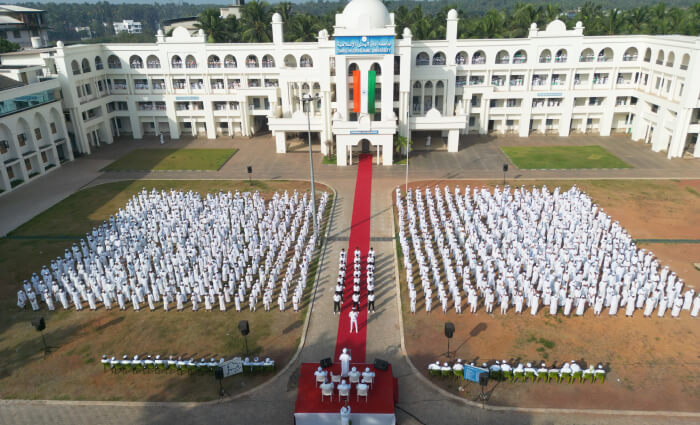
In the discourse surrounding Islamic education within the modernist trend, a notable shift in the 20th century, emerged characterised by movements toward de-westernisation and de-secularisation, notably achieved through the Islamisation of the educational curriculum. Scholars such as Naqib al-Attas and Hashim Rosnani contributed significantly in shaping frameworks for the integration of Islamic education in the 20th century. The article looks into the evolution of integrated Islamic education and its applicability in the context of Darul Huda Islamic University (DHIU), Kerala.
Naqib al-Attas, in his educational philosophy, emphasizes a holistic approach to education, which encompasses the disciplining of the mind, body, and soul. According to Al-Attas, education serves as a means of refining individuals mental, spiritual, and physical capacities, ultimately aiming to cultivate virtuous and morally upright human beings. Central to his perspective is the notion that education should not only impart knowledge but also instil ethical values and foster personal development across all dimensions of human existence.
From an Islamic standpoint, knowledge is classified into two categories: Fard Ayn (individually obligatory) and Fard Kifayah (collectively obligatory). The former pertains to the essential knowledge that every individual must acquire, comprising disciplines such as Quranic studies, Hadith, theology, and Islamic metaphysics. These subjects are considered foundational as they encompass revealed or transmitted sciences crucial for spiritual and intellectual development within the Islamic tradition. On the other hand, Fard Kifayah encompasses knowledge in natural sciences, applied sciences, and technological sciences. This category denotes knowledge that is collectively obligatory, meaning that as long as a sufficient number of individuals within the community possess expertise in these areas, the obligation is fulfilled for the entire community. Fard Kifayah subjects are essential for the advancement of society, contributing to practical innovations, problem-solving, and societal progress.
Al-Attas proposed to reconcile and integrate Islamic science with Western science by harmonising the realms of revealed sciences, representing Fard Ayn, with the sciences categorised as collectively obligatory, such as those pertaining to natural, applied, and technological fields. This integration strategy aims to bridge the gap between traditional Islamic knowledge systems and modern scientific advancements, fostering a comprehensive approach to knowledge acquisition that incorporates both religious insights and practical disciplines essential for societal progress. Al-Attas advocated for a synthesis that honours Islamic revelation's foundational principles while acknowledging Western scientific methodologies' contributions and relevance, thereby fostering a holistic understanding of the universe and human existence within an Islamic epistemological framework.
Building upon the groundwork laid by Al-Attas, Rosnani critiques his approach as insufficiently holistic. She contends that while Al-Attas' model integrates Islamic and Western scientific traditions, it fails to provide a comprehensive framework. In response, Rosnani advocates for the development of an intellectual Islamic curriculum that surpasses Al-Attas' model. This curriculum is constructed by amalgamating elements from Al-Attas' framework and the Western liberal education model. Rosnani's proposed model aims to address the perceived gaps in Al-Attas' approach by offering a more nuanced and inclusive educational structure that embraces both Islamic epistemology and the broader spectrum of knowledge found within Western educational paradigms.
The Western education model, which typically features a core curriculum consisting of a single subject from each major discipline, Rosnani advocates for a more expansive approach in her proposed educational framework. This framework encompasses diverse fields such as art, literature, history, social sciences, philosophical analysis, natural sciences, mathematics, and religious studies. Rosnani's proposal emphasizes the importance of students engaging with a broad spectrum of knowledge, allowing them to explore various intellectual domains and develop a comprehensive understanding of the world. Rosnani's proposal challenges the traditional boundaries of education by promoting interdisciplinary exploration and encouraging students to actively shape their educational experiences. By incorporating elements of both Western and Islamic educational philosophies, Rosnani seeks to create a dynamic learning environment that prepares students to navigate the complexities of the modern world while also fostering a sense of cultural identity and intellectual curiosity.
International Islamic University incorporated Attas and Rosnani model in their curriculum. In 2011, the DHIU, affiliated with the International Islamic University (IIUM) Malaysia, signed MoU for academic exchange programme. Following their academic commitment, a group of students who completed their education at IIUM assumed teaching positions at DHIU. This research seeks the intricacies of Islamic education in Kerala, specifically examining the manner in which educational institutions like DHIU have embraced innovation in curriculum development to address contemporary needs and challenges.
The educational infrastructure for DHIU emerged from the traditional system of Dars in Kerala and recently emerged Sharia colleges. The Dars education mainly focuses on theological studies within the context of mosque. However, the mosques were later in the 1970s adopted secular modern education along with theological studies. On the other hand, there were Sharia colleges like Jamia Nooriya Islamia, Pattikad, which was an institutionalized mode in traditional Islamic education that offered specialization in theological studies. Irrespective of the affiliations with reformist or traditionalist, the Sunni sect have played significant roles in the modernisation of Islamic education during the early 20th century.
Bashir Musliyar a pioneering figure behind Matrika Dars, proposed a combined education model to Sunni Mahallu Federation (SMF), the organisation and network for local mosques in Kerala, in 1986. He thought the graduates from Dars should be left behind in attaining quality education and employment. Rather, they should be aware of trends in modern education and they should relate Islamic perspectives to emerging questions of modern science. The curriculum should balance Islamic and secular education, and the ulama must look into alternatives that emerged out of modern education. The graduates must act as a philosopher cum scientific scholar of the middle ages.
Thus, Darul Huda Islamic Academy was established in 1986. The DHIU committee passed a constitution for the madrasa in 1989. First, to produce exemplary scholars who can lead Da'wa or Islamic propagation globally. Second, to produce scientific strategies for revitalising Islamic education according to the needs of the Muslim community, Kerala in particular. Third, graduate schools and research centres should be established with a specialisation in religious studies. Fourth, a Quranic Study Institute should be established to enhance and promote Quranic-oriented research. Fifth, teachers' training institutes should be established to train preachers and teachers of Islamic sciences. Sixth, to promote research in Islamic sciences to produce textbooks for Islamic education. Seventh, to establish a reference library for promoting research in Islamic sciences. And eighth, to establish professional training centres for graduates of the institute.
The curriculum of DHIU is divided into three parts: theological studies, auxiliary sciences, and secular sciences. In the theological studies, the curriculum followed the traditional Ponnani education, offering classical Islamic texts in Shafii school. The texts extends from Muqaddimat al-Hadr-amiyya, Matn Safinat al-Najāt, Fath al-Muin, Kanz al-Ragibīn to Tuhfat al-Muhtāj. In Hadith studies, it offers Matn al-Arbain and Riyad al-Salihīn by Imam Nawawi and Sihah al-Sitta, the core six classical texts in Hadith studies. In the field of Tafsir, the curriculum includes the study of Tafsir al-Jalalayn by Imam Mahalli and Suyuti, followed by Madārik al-Tanzil by Imam Nasafi and Tafsir al-Kashaf by Imam Zamakshari.
In the auxiliary sciences, the curriculum offers a thorough and deep understanding of classical Arabic literature along with classical texts in Arabic grammar. The curriculum features Muntaqabāt, a collection of poems and prose in Arabic language and modern morphology section introduces Nahw al-Wadih by Egyptian scholars Mustafa Amin and Ali Jarim. However, in the secular sciences, students acquire a vocabulary and translation skill in four languages: English, Arabic, Urdu, and Malayalam. The curriculum aligns with government school syllabi up to the secondary level for Malayalam, English, Hindi, social sciences, mathematics, and general sciences. Additionally, students are required to attain basic computer literacy through practical instruction.
In conclusion, DHIU offered an integrated model in Islamic education, a combined mode of traditional Islamic education with modern secular sciences. The curriculum succeeded in reforming traditional Islamic education and produced a large chunk of Hudawis, the alumni of DHIU, committed to the dissemination of Islamic teaching across the world. In the last forty years, the DHIU model institutionalised a model in the Islamic education to address the emerging modern challenges.