
The art of the Qur’an in the Indian Ocean world: a view from Southeast Asia

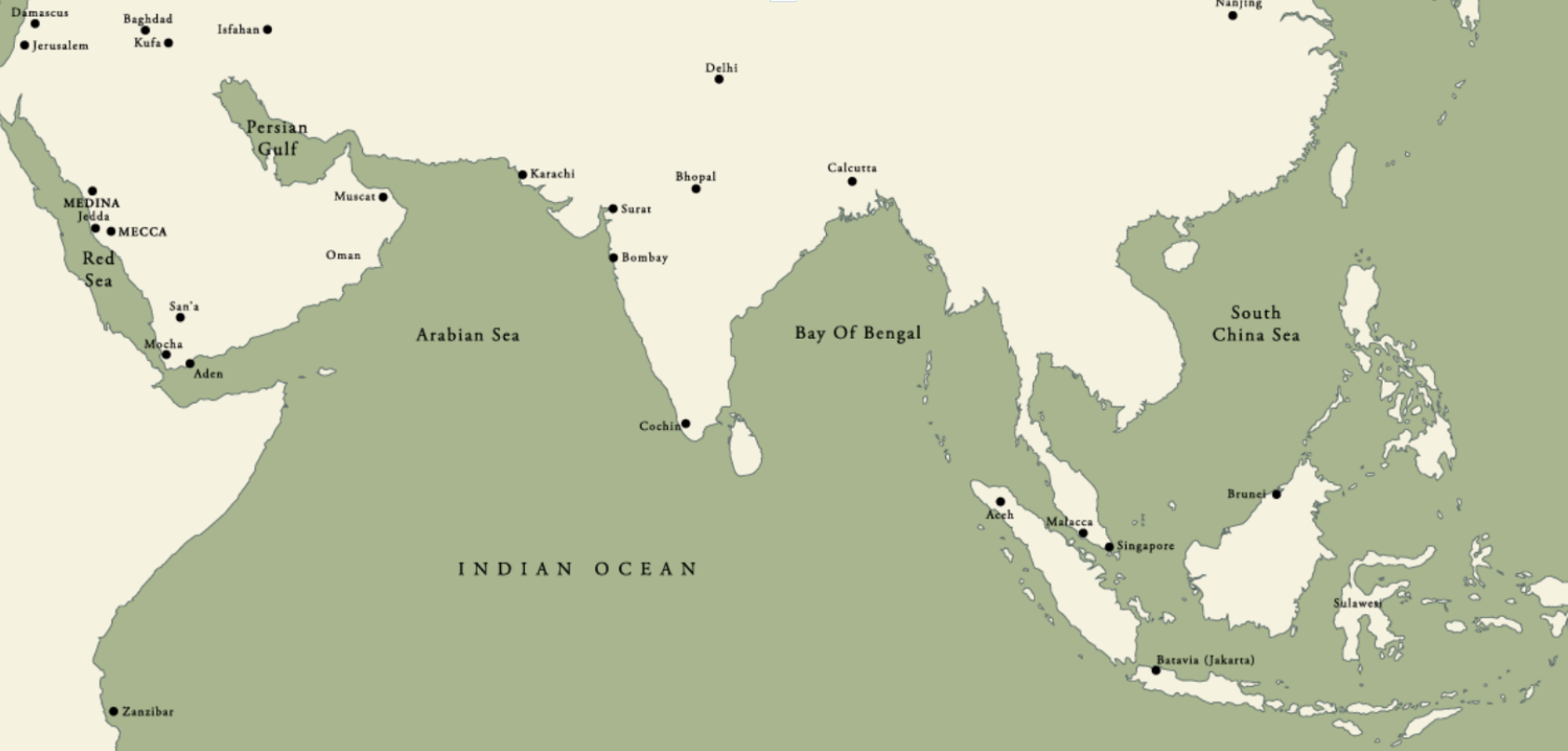
Map: The Indian Ocean world
When I first began exploring the art of the Qur’an in Southeast Asia, more than twenty years ago, the canvas was essentially blank. The art of the Islamic book had rarely attracted attention in the Malay world of ‘Nusantara’, and almost no photographs of illuminated Southeast Asian Qur’an manuscripts had ever been published.
This was because philological studies – and thus also university teaching programmes – on Indonesian and Malay manuscripts had traditionally focussed on texts in vernacular languages such as Malay, Acehnese, Javanese and Bugis. There was little interest in the codicology or materiality of manuscripts, or in books in Arabic from the region, as these were generally seen as poor relations of their counterparts in the central Islamic lands.
But once the hunt began, many beautiful Islamic manuscripts from Nusantara were found hiding in plain sight, in public libraries and museums, as well as in mosques and private collections that were increasingly brought to light by digitisation programmes such as the Endangered Archives Programme↗ and DREAMSEA ↗. To date, about 1,500 Qur’an manuscripts from Southeast Asia have been documented, many of them illuminated (see Ali Akbar’s blog↗ and the Indonesian Ministry of Religious Affairs online database of Qur’an manuscripts↗). The vast majority of these manuscripts are held in the region itself, with only around a hundred Qur’ans held elsewhere, mainly in Europe with a few in North America and the Middle East. A number of regional schools of Islamic manuscript art can be identified, including from Aceh on the tip of north Sumatra, and from Terengganu and Patani (Fig. 1) on the east coast of the Malay peninsula. Java is also home to large numbers of illuminated Qur’ans, but with such a variety of forms of decoration that it is not possible to talk of a single ‘Javanese style’ of manuscript art. Most of these illuminated Qur’ans date from the 19th century; from the earlier period of the 17th and 18th centuries far fewer manuscripts were known, although a distinctive ‘Sulawesi diaspora geometric style’ can be discerned (Gallop 2024), as well as a calligraphically-impressive small corpus linked to the court of Banten in west Java (Gallop and Akbar 2006).
Despite clear regional variations, it is still possible to talk about ‘Southeast Asian’ commonalities in Qur’anic illumination. Double decorated frames around the text nearly always have an arched outline on each of the three outer sides of a page, probably reflecting a profound and deeply-rooted attachment throughout the archipelago to the (cosmic) mountain motif, and indeed, in a manuscript source from Aceh, these illuminated arches on the page are labelled gunung-gunung, ‘mountains’. This contrasts with, for example, norms in Ottoman and Persian illumination, where the outline of the decorated frames across two facing pages is essentially rectangular, albeit scalloped or petalled.

Fig. 1. Opening illuminated frames of a Qur’an manuscript from Patani, Malay peninsula, 19th c. British Library, Or. 15227, ff. 2v-3r
When present in a Qur’an manuscript from Southeast Asia, decorated frames around the text are only found at certain key junctures: at the beginning, nearly always enclosing Surat al-Fatihah on the right-hand page and the first few verses of Surat al-Baqarah on the left-hand page; sometimes also at the end, and occasionally in the middle. If decorated frames are included in the middle of the Qur’an, their precise location is determined by regional origin: at the beginning of Surat al-Kahf (Q.18) in manuscripts from Java and linked to the Sulawesi diaspora; at the beginning of Surat al-Isra’ (Q.17) in Qur’ans from the east coast of the Malay peninsula; and at the beginning of juz’ 16 (Q.18:75), in Qur’ans from Aceh. All other pages of a Southeast Asian Qur’an are generally quite plain, although the text is usually set neatly within ruled ink frames of different colours, mainly red and black (the composition of which is again regionally determined), and there may be marginal ornaments marking textual divisions such as parts of a juz’, and the letter ‘ayn signifying ruku‘, thematic sections for recitation.
The primary colour used in Qur’anic manuscript illumination throughout the archipelago is red, always combined with black ink outlines, while the reserved white of the background paper is manipulated by the artist as an essential third element of the palette (for white pigment is never used). Yellow is the next more prominent colour, followed to a lesser extent by others including blue, brown and green. Gold is found only in certain areas: it is applied intensely and lavishly in Terengganu and some other parts of the east coast of the peninsula, and in some Qur’ans from Java and Madura, but never in Aceh and hardly ever in other parts of Sumatra or Sulawesi. Calligraphy ranges from competent to poor, but is rarely remarkable for discipline or elegance. Terengganu stands out as a beacon of excellence for both calligraphy and illumination, to an extent hardly matched anywhere else in the archipelago (Gallop 2005).
Yet even as the picture of Southeast Asian Qur’anic illumination was becoming clearer, I was surprised to find almost no resonances with any of the well-known and much-published styles of Qur’anic art from the broader Islamic world, from the Maghreb through to the Ottoman realm, or even compared to Mughal Qur’ans from India, despite the long and close ties between the subcontinent and the Malay archipelago. Early tombstone evidence suggests China played a major role in the development of Islam in Sulu and Brunei, but a forensic examination of Qur’an manuscripts from China – which started flooding the international Islamic art market from the late 1980s onwards – in search of links with Southeast Asian Islamic manuscript art revealed few real similarities, and felt like an exercise in grasping at straws (Gallop 2009). Admittedly, it is important to compare like with like, and many of these above-mentioned manuscript cultures were much older than the predominantly 18th and 19th century illuminated Qur’ans of Southeast Asia.
The last great unknown – in terms of Islamic manuscript art – ironically, was not some arid landlocked region far off the beaten track, but the lands surrounding what were the most cosmopolitan and oft-traversed maritime trade routes in history: the Indian Ocean littoral, stretching in the west from the Cape upwards along the eastern coast of Africa, across the southern shores of the Arabian Peninsula, through the scattered islands of the Indian Ocean, and along both southern coasts of India, up to Bengal and down via coastal Burma to the Malay peninsula and the archipelago. Fortuitously, over the past decade, a range of academic and community activities taking place separately and coincidentally across these sites have meant that for the first time we are able to see what Qur’an manuscripts from these regions look like. In almost every case glimpses of artistic affinities with the art of the Islamic book in Southeast Asia are revealed, as will be traced in the case studies below.
South Africa
Starting in the far south, in South Africa at the Cape, Southeast Asian references in Islamic manuscripts are only to be expected because Islam was brought to the Cape by exiles from Java, Sulawesi, Maluku and other parts of present-day Indonesia, banished thence from the 17th century onwards by the Dutch East India Company (VOC). The most famous such personage was Syaikh Yusuf of Makassar, sent first to Sri Lanka but still perceived as such a threat by the Dutch that he was then removed to their furthest outpost in the Cape, where he died in 1699. Perhaps the oldest Qur’an known from South Africa is a manuscript, in a recognizably Javanese style and hand, now held in Utrecht University Library, Or. 27 (Fig. 2). It was presented in 1749 on behalf of Hendrik Swellengrebel (1700-1760), who was born at the Cape and served as Govenor from 1739-1751, as part of his campaign to win burghership for his son who had settled in Utrecht (pers. comm., Prof.em.dr. G.J. Schutte, 20.1.2026; cf. Gosselink 2017: 98-99).

Fig. 2. Qur’an, in early Javanese style script and layout, brought from the Cape and presented to the City of Utrecht by Hendrik Swellengrebel, 1749. Utrecht University Library, Or. 27.
Another notable exile from Indonesia, Tuan Guru Abdullah from Tidore, was sent to the Cape in 1780, where he died in 1807 (cf. Laffan 2022). He was responsible for copying some of the most important Islamic manuscripts still held in South Africa today, including three copies of the Qur’an (with the word Allah always written in red ink) and several other religious texts in Malay and Arabic (cf. Gosselink 2017: 142-143). One of his Qur’an manuscripts has geometrical and foliate patterns in red and black on the first pages (Fig. 3).

Fig. 3. Detail from a decorated page containing the start of Surat al-Baqarah, in a Qur’an copied in the Cape by Tuan Guru Abdullah from Tidore, Maluku, late 18th century. Image source: Allie 2023↗
Coastal East Africa
For the Swahili coast of East Africa, since 2019 Zulfikar Hirji, of York University, Toronto, has published a series of detailed and increasingly insightful studies of a small corpus of Qur’ans. These manuscripts were produced between about 1750 and 1850 in the historical Muslim city-states of Pate, Siyu, and Faza on Pate Island in the Lamu Archipelago in present-day Kenya. Although to date only 12 Qur’an manuscripts have been documented, they reflect an extraordinarily rich theological and graphically-striking manuscript tradition, with a bold palette centred on red, yellow and black. The surah headings in red are followed by a detailed text extolling the values of that particular surah, and the initial basmalah is presented in large stylised calligraphy within an ornate cartouche. Located alongside is a bold colourful marginal ornament indicating the start of a new surah, while textual annotations in the margin are set within carefully demarcated ruled frames (Fig. 4).
While the palette preferences in these Swahili coast Qur’ans are similar to those in Southeast Asia, many of the other artistic choices are very different. So too are the theologically detailed additions, for most Qur’ans in the Malay world have relatively clean margins save for juz’ (and parts thereof) markers, with no extra-Qur’anic texts in the volume. However, a Terengganu Qur’an manuscript, which was evidently created as a typically sparse and ‘clean’ copy, appears to have had an overlay of annotations on almost every page. Particularly striking are the colourful sajdah markers added in the margin, completely alien to any Malay-world aesthetic, but which are not dissimilar in graphic impact from those in Qur’ans from coastal East Africa (Figs 5-7). These textual and ornamental additions, and the unusual red ruled outer page frame, may indicate an afterlife for this manuscript outside Southeast Asia, until it was purchased at auction in London in 2012 and brought back to Malaysia, where it is now held in the Islamic Arts Museum Malaysia in Kuala Lumpur.

Fig. 4. Qur’an manuscript, copied by Qadi ‘Abd al-Karim al-Nawfali, ca. 1859, Faza, Pate Island. Maalim Muhammad Idris Collection, Zanzibar, Tanzania. EAP1114/1/123↗, image 176. , see Hirji 2022.

Fig. 5. Qur’an manuscript, Terengganu, 19th century, with marginal annotations in coloured inks and colourful sajdah markers in a graphic style unusual for Southeast Asia. Islamic Arts Museum Malaysia, 2012.13.6


Figs 6 and 7. Two further unusual sajdah marginal markers in the Terengganu Qur’an, 19th c. Islamic Arts Museum Malaysia, 2012.13.6.
Ethiopia
Continuing northwards up the coast of East Africa, since 2017 Sana Mirza has been publishing results from her doctoral study (completed in 2021) of a large corpus of Qur’an manuscripts from the city of Harar in eastern Ethiopia. The manuscripts were copied between the seventeenth and nineteenth centuries, and in her publications Mirza contextualises their production and use within their Red Sea and Indian Ocean milieus. Similarly to the Swahili coast Qur’ans, the Harar Qur’ans are theologically impressive, with dense textual annotations and additions, and are equally graphically striking, albeit in a more sombre palette dominated by red, black, ochre and earthy brown (Fig. 8).
As noted above, such copious annotation is rarely found in Southeast Asian Qur’ans, but one particular feature of the illumination of Ethiopian Qur’ans has particular resonance for Qur’an manuscripts from Aceh: the twisted or plaited rope motif, picked out in reserved white on a coloured ground (Fig. 9). The plaited rope motif is of course common in many artistic manifestations all over the world from Roman times onward, yet is definitely more prominent in some cultures than in others. In the Malay world, twisted (two ropes) or plaited (three interwoven ropes) rope motifs play a major role in Acehnese illumination, but are is not found in illuminated Qur’ans from any other region in Southeast Asia.

Fig. 8. Qur’an manuscript, with a twisted rope border, late 18th c., Harar, Ethiopia, endowed by Hasan ibn Adojo. Princeton University Library, Islamic Manuscripts, Third Series no.900q. Mirza 2025.

Fig. 9. Qur’an manuscript, with twisted and plaited rope borders, 19th c., Aceh. Yayasan Ali Hasjmy, Banda Aceh. Photograph by A.Gallop, 1993.
Yemen
Yemen is home to some of the most famous Qur’anic manuscripts in history: the cache discovered in the Great Mosque of Sana’a during restoration in 1972 includes the Sana’a palimpsest, which has been dated to the 7th century. But almost no studies have been published about the art and materiality of later Yemeni manuscripts, dating from the 16th centuries onwards, as most academic interest during this period has focused on theological and textual issues, especially relating to Zaydi thought. Large digitisation programmes of Yemeni manuscripts have been carried out, including of collections held at Princeton↗ and Leiden↗ university libraries, and of manuscripts in Yemen through HMML↗, and so the material is at least now accessible for study. Yemen was closely integrated into Hajj maritime networks, and many scholars from Southeast Asia sojourned for long periods in study centres such as Zabid en route to the Holy Cities of the Hijaz (cf. Gallop and Regourd 2024). Yet visual congruences between Yemeni and Southeast Asian manuscripts are more evident in smaller elements such as the scalloped edges of triangular colophons and the shadowing in red of elements of letters, than in larger illuminated frames (Figs 10-11).

Fig. 10. Scalloped tapered frame, with red pigment shadowing of certain letters, at end of a Yemeni Qur’an manuscript, 19th c. Leiden University Library, Or. 25.180↗
Fig. 11. Colophon with scalloped frame, with red ink shadowing of letters in the supplication at the end of a Sulawesi diaspora geometric style Qur’an, copied by a scribe from Yemen, Ibrahim of Zabid, dated 1740. Museum Sang Nila Utama, Pekanbaru, Riau, 07-15.
Oman
A richly varied manuscript culture is evident in collections in Oman reflecting its pivotal position in the Indian Ocean world, as the Sultans of Oman ruled Zanzibar from the late 17th to the early 20th centuries. Omani manuscript collections were first brought to wider attention with the publication in 2008 of a book on the Islamic art of Oman, which included a chapter on Omani Qur’anic manuscripts (al-Salimi and al-Hafiyan 2008). Since then there have been other important publications, and a valuable government website of Omani manuscripts.
Rather than manifesting any one distinctive artistic style, the Qur’anic manuscript art of Oman – or rather, of manuscripts now found in Oman – reflects myriad networks and connections, with echoes of Yemeni, Ethiopian and Swahili coast illumination, as well as Ottoman, Persian and Indian influences. In relation to Southeast Asia, one truly hybrid Qur’an manuscript in the Omani national collection is of particular interest. The opening pages, with double decorated headpiece frames, have red hatching within the cloudbands surrounding the text; this red hatching is a feature common to many Omani Qur’ans, but is never found in Southeast Asia. On the other hand, the illuminated headpiece with red and yellow arched forms around a domed base, and with floral rays and tendrils reaching upwards, bears a remarkably strong resemblance in shape and palette to Terengganu-style illumination (Fig. 12). For comparative purposes, shown alongside the Omani Qur’an below is not a Malay Qur’an but a kitab mawlid manuscript with decorated headpieces in the Terengganu style, containing prayers and praises for the prophet and telling of his birth and life (Fig. 13). This is because in Southeast Asia, Qur’an manuscripts are nearly always adorned with full double illuminated frames, arched on all three outer sides, and hardly ever with headpieces, which tend to be found in manuscripts of a less elevated stature, such as mawlid texts or copies of the Dala’il al-khayrat, another text in praise of the prophet.

Fig. 12. Left-hand initial page of a Qur’an manuscript, with decorated double headpiece. Image source: Omani manuscripts.↗
Fig. 13. Right-hand page of a manuscript of Mawlid sharaf al-anam, illuminated in the Terengganu style, copied by Abdul Wahab ibn Ibrahim Ambon of Pulau Pinang in 1855 and illuminated by Haji Ahmad for Pangeran Ratu Anum of Kotaringin, now held in the palace of the Pangeran Adipati Mangkubumi in Pangkalan Bun, Kotawaringin, Kalimantan. Dreamsea DS 0136 00002.↗
Maldives
Since 2020 the Maritime Asia Heritage Survey↗ has been making accessible online images of the manuscript traditions of the Maldives, one of the least-known areas of the world in the terms of its Islamic cultural heritage. Historically the Maldives was of great importance to trade networks of the Malay archipelago and of Aceh in particular. This is evidenced by references in the Adat Aceh, the 17th-century compendium of Aceh port and harbour laws, to special taxes for kembal emas or ‘stockfish’, dried mackeral or tuna from the Maldives, which was a staple of the Acehnese diet. A considerable number of Maldives Qur’an manuscripts – many in multi-volume sets, dating from the 17th to 19th centuries – have been digitised by MAHS, and show a fine calligraphic capability. Not many manuscripts are illuminated, but those that are show a marked preference for complex square knot motifs (Fig. 14). These examples immediately shed light on one of the most enigmatic illuminated manuscripts from Aceh: an 18th century kitab mawlid, a copy of Mawlid sharaf al-anam in Arabic with interlinear Malay translation, with decorative frames completely unrelated to any other illuminated manuscripts in Aceh, but which can now be recognized as linked to the Maldivian style (Fig. 15).